Wednesday, 10 March 2010

Week 16 Recruitment

• Go on the internet and review an on-line recruitment site such as www.monster.co.uk, www.fish4jobs.co.uk,
Comment on the use of the site, layout, accessibility etc.

Fish4jobs
On the Fish4jobs.co.uk web site there were plenty of unrelated adverts, for example car, holidays and homes. At first I thought I have logged on to the incorrect web site. Their home page was full of adverts and it was too busy, by which I mean there was too much information going on at once.
Also there were plenty of pop-up adverts which led to slowing down the loading time. But there were some advantages of using this site which are that it can help the candidate to calculate estimated monthly wages but they have to be a member to use this service.
Another advantage is that Fish4jobs.co provides advice, for example, C.V. advice and at the bottom of the page there is a help link however I did not find it useful because there is insufficient information.

Monster
Monster.co.uk web site has provided an optional link which is where the candidate can look into the related sectors, or can just type in the job search which will bring up the available posts at the current moment. The advantage of using this site is that the user can get information about the company that they have an interest in.
The disadvantage of this site is that the user has to click too many times to get the information needed
My overall opinion on this site is they are an acceptable professional web site to use.

Both
They both have simple and clear lay out of the job descriptions. To attract the candidates they have provided essential information at the beginning of each job description, for example, outlines of duties, wages and salary.

• Brainstorm five advantages and five drawbacks of on-line recruitment.

Five advantages of on-line recruiting
1. Easier to short list
2. Save time and money (work efficiencies)
3. Reach wider range of candidates (can be worldwide depending on the job or organisation)
4. Provide more customised information relating to the position
5. Candidates can access the web site 24 hours a day, 7 days a week


Five disadvantages of on-line recruiting
1. On-line security (due to hackers and viruses)
2. Some candidates maybe unable to fully use the technology due to their disability
3. Design and mapping of the web site (If unattractive or too confusing web sites may put off candidates.
4. High competition, for example, search engines ranking
5. On-line recruiting may not be the first option for candidates

• Identify a recruitment campaign which has really interested you. Explain why you feel this campaign caught your interest.


http://adhunt.blogspot.com/2008/11/careerbuildercom.html

Nowadays competition recruitment process needs to be creative on one side and professional to attract the candidates to apply. One of the major tools that are being used by all types of companies is the internet because it provides one of the fastest channels of advertising and attracting candidates. Careerbuilder.com is trying to attract more candidates to sign up using their site and the message they are trying to send across is ‘Maybe it’s time to move on’.
The reason why this campaign attracted me is because it links to the business sector and when I graduate from university, I would like to go into banking industry and it is linked to the course that I am studying at the moment. Also I always had an interest in investments.

• Go onto the CIPD website and read and explain what you understand by the Psychological contract http://www.cipd.co.uk/subjects/empreltns/psycntrct/psycontr.htm


According to the CIPD (The Chartered Institute of Personnel and Development) (2009) the term of psychological contract was firstly introduced in the 1960s and it became popular in the 1990s. The meaning of psychological contract is an agreement or commitment between employer and employees.
Usually these agreements are informal and sometimes vague. When agreements are not written down then this mean they are set apart from the formal contract like employment contract.
It is expected by parties that they will do or act professionally, for example, personal hygiene, an employee is not allowed to wear after shave or perfume that is too strong. When either side of the parties does not perform as expected this will lead to psychological contract breakdowns and staff may leave the company due to negative emotions between parties.

Conclusion
To conclude all personnel need to act professionally during their shifts and also one of the most important points of agreements is to respect each other. The importance of psychological contract is that it contributed to relationship between all staff.

Bibliography and Reference

Career builder [online] Available at: http://www.careedrbuilder.com/default.aspx?cbRecursionCnt=1&cbsid=13f9b2b53f844c688a8af3d4b20077bb-320847359-RT-4&ns_siteid=ns_us_g_careerbuilder
[Accessed 25 February 2010].

CIPD (2009). The psychological contract [online] Available at: http://www.cipd.co.uk/subjects/empreltns/psycntrct/psycontr.htm [Accessed 25 February 2010].

Fish 4 jobs (n.d) Job search [online] Available at: www.fish4jobs.co.uk [Accessed 25 February]

Foot, M. and Hook, C. (2009) Introducing human resource management.5th ed. Harlow: Pearson Education Limited.

Monster (n.d) Your call is calling [online] Available at: www.monster.co.uk [Accessed 25 February]

Wednesday, 3 February 2010

teamwork week 13

• Give an example of a time when you have worked in a team and you were successful. Identify why you feel this team worked so successfully using relevant theory bases.

During my college career, I have worked in teams for lots of different activities and it has provided me many different experiences.
Our project was to produced a business plan and the web site for our business.
When we came together all of us were from different classes just for this project.
Out of all the team work team that I was involved in this one was the most successful. This was because we were well organised and everyone had pull their weight also I was the team leader in that occasion.
One of the main reasons why I felt it was successful is because we could trust each other and one of our team members has actually used the business plan to set up the business that we produced.
According to Belbin (1993) to make a successful team necessary have different role players and Belbin has identify nine different roles such as shaper which like to be challenge and likes to motivate the team.
Implementers are the people who turn ideas into actions and usually they are well organised.
Complete finisher which is people who goes through the whole entire project and make sure everything tasks is completed.
Coordinators are usually the leader in the team and skilled at listening to team members so he or she can recognise their team members’ skills.
Team worker are those who support and making sure the team is completing the tasks and they usually get along with all the team members.
Resource Investigator is those who like to find out investigate the available options.
Plant is usually the creative team member and they likes to come up with new ideas.
Monitor Evaluator is the skilled at evaluating ideas and carefully points out the pros and cons of the ideas.
Specialist which is people has the knowledge to get the task done and they are expert in their field.
Another reason why I felt it was successful is because everyone different roles and there were three team members. Everyone had different skills, for example, one of the team members was very creative and according to Belbin (1993) he is classified as a plant. Everyone was a team worker because we supported each other throughout our tasks.
One of our team members was a resource investigator because she collected all the information that we needed in order to produce the business plan. I was the completer because I made sure everyone completed their part of the tasks


• Using Tuckman’s theory on group development, review the group you worked with for your first assignment for People and Orgs. Did your group progress through all of the key stages? Relate this to the success, or otherwise, of the group.

In 1965 Tuckman introduced four "Tuckman's Stages" for a group which are Forming, Storming, Norrming and Performing.
Forming – is when groups come together to get to know each other and this is the beginning stage. Usually the group members are polite, protective and this is the bonding satge.
Storming – this is where team members start to have issues with one another and it can be anything, for example, have different ideas and views. If this issues is handled unsuccessfully it can make team members leave the group.
In Tuckman (1965) this is one of the most important stages for a group to go through in order to reach norming.
Norming – at this stage the group starts to develop trust in each other and agrees with the tasks.
Performing – this is where the group works toward their aims and they are comfortable with the people they are working with.

In 1977 Tuckman have introduced the new fifth stage which is Adjourning, which is where the group and the tasks come to an end. Team members may feel anxiety or sadness about the separation.

In our first assignment for People and Organisation we formed a team.
Our team performance and overall issues was well managed because in the first stage we all knew each other for reasonable amount of time.
In the storming stage, we did come across some different ideas and views but the problem was quickly resolved. Also everyone contributed the best they can.
In the norming stage we all knew what our tasks were and when the deadline is. In one of the planning stages we organised tasks sheet which indicated what we needed to do and when.
In the performing stage we achieved the aim which is to pass the assignment.
On the adjourning stage were not quite there because we were still working in the same team but this time for another assignment.


• Using the link below to “The Times Top 100 companies to work for”, review 2 companies where teamwork has been identified as a major contributory factor to their success.
http://business.timesonline.co.uk/tol/business/career_and_jobs/best_100_companies/
The two companies that I have chosen are Beaverbrooks the Jewellers and Edward Jones which provide financial services. According to the Sunday Times (2009) Beaver Brooks was given first top place for companies to work for and closely followed by Edward Jones.
When I visited Beaver Brooks and asked a member of staff “what is like working for Beaver Brooks” and the staff answered we have regular team work activities and it is consider the base structure of the company because the activities can strengthen up our relationships with other members.
Also the environment is always friendly and all the member of staff has sense belonging like a family.
According to Edward Jones web site mentioned they want build long term relationships not only with the clients but also their staff too. Also according to their web “a true partnership is our home who shares combination of passion for serving our clients and moving careers forward”.


Bibliography and References

Chimaera consulting limited (2001) Famous models stages of group development [online] Available at: http://www.chimaeraconsulting.com/tuckman.htm [Accessed 3 January 2010]

Edward Jones (2010) Welcome to your Edward Jones [online] Available at: http://careers.edwardjones.com/us/index.html [Accessed 3 January 2010]

Mind tools limited (1995) Belbin team roles [online] Available at: http://www.mindtools.com/pages/article/newLDR_83.htm [Accessed 3 January 2010]

The team building company (2010) Forming, storming, norming, performing [online] Available at: http://www.teambuilding.co.uk/Forming_Storming_Norming_Performing.html [Accessed 3 January 2010]

Tuesday, 2 February 2010

week 15 HR Planning

• Explain why it is vital for organisations to have HR plans. What might be the problems if they do not?
It is very important for an organisation to have human resources (HR) plans because the plan provides an outline all the tasks that the organisation needs to cover, for example, how many people does the organisation need in order to complete the tasks or duties and what skills, qualifications and any special licences, for example, fork lift truck are needed (Mullins, 2007). It also outlines the budget for the organisation so managers know how much they need in order to achieve the tasks.
The planning can analyse and investigating what sort of problems that the organisation can avoid. It can also provide solutions, for example, budget training so managers do not over spend.
If an organisation does not do any HR planning then tasks and duties may be jeopardised and especially HR managers will find it harder to achieve their aims and the organisation may breach regulations and laws. If an organisation does not do any planning then all the money and time maybe wasted because the organisation may employ the wrong person to do the tasks or provided the incorrect training for the staff. Lack of a clear job description can lead to many problems, for example, unsuitable candidates may apply. This will lead to a high staff turnover and it will affect the public image to the organisation.

• Using Rodger’s seven point person specification (in Foot and Hook) draft a person specification for a university lecturer.
In 1952 Alec Rodger introduced the seven point person specification and it is one of the best known theories to use in it field (Foot and Hook, 2009).
To explain the seven points person specification by using a university lecturer specification:-

Physical make up – this includes a healthy life style, also should have clear and good communication – speaking, presentations skills, full express themselves on the subject.

Attainments – degree in education - teaching and motivation skills, should have experienced in the teaching industry and give guidance to students.

Intelligence – adept to new equipments, be creative and able to improvise

Aptitudes – abilities to operate day to day equipment e.g. IT.

Interest – should enjoy socially interact with students and lecturers.

Disposition – good sense of humour, willing to improve knowledge.

Circumstances - must be will to give up their own time, for example, cover other lecturers lesion, may need own transportation.


• If Waitrose were considering opening a new store in High Wycombe, what are the key labour questions they would need to ask. Give at least 5 answers.

When Waitrose is considering opening a new store in High Wycombe, Waitrose should take the following into account because it can determine if the project will be profitable or not.

Demography and Geography in the area, what sort of age group is the highest
What is the level of education in the?
What is their average income?
Where is the location of the store?
What is the unemployment rate in the area?
Is there any government support e.g. grant?
How many competitors are in that area?

In conclusion it is very important for an organisation to do HR planning before carrying out any tasks and it also makes the aims clearer. The plan outlines the problems that organisations need to take into account, which may lead to better performance.

References:
1) Foot, M. and Hook, C. (2009). Introducing Human Resource Management. 5th ed. Harlow: Pearson Education Limited.
2) Mullins, L. J. (2007). Management and Organisational Behaviour. 8th ed. Harlow: FT Prentice Hall.

Monday, 25 January 2010

Week 8 Enterprise

The apprentice challenge the aim of this challenge is to make the most profit over three challenges.
When our team leader Sander came back from the meeting he asked the entire class are we interested in the apprentice challenge. So I have decided to sign up for because it will be interesting. Our team member includes Sidsel, Katarzyna, Hanas, Jagoda, Sander and me also luckily we manage to hand in the application form before the deadline. Our team name was Bunkey, the reason why we called our team Bunkey is because it is funky and reminds us Bucks New University. I missed the first meeting due to personal issues. But Sander e-mailed me the minutes so I knew what the plan is. We were sponsored by AMT Coffee.

Firstly we got given £50 by our sponsor as starting cash so we can buy the materials that we need and our first challenge was to sell doughnuts around High Wycombe. Once we made a time to meet we discussed how we were going to market our doughnuts. Then we decided to market them as lucky doughnuts. The reason why we called them lucky doughnuts is because in each one there is a fortune message inside and we neatly wrapped each doughnut. The first stage of the challenge started at 11am to 3pm and we decided to split the team in two, I and Sander went around the university and the rest was at the city centre. We were selling for a pound each and we manage to sell most 140 doughnuts but at the end we had nine left.
The second challenge was to make our own products to sell at the Eden Centre. So we decided to sell handmade Christmas cards, decorations and offer give wrapping service. We planed out everything on a PowerPoint presentation and we presented our ideas to the Eden Centre manager and had to choose six teams out of the nine. At the end we were one of the chosen ones and this was a great opportunity for all of us to show own abilities and improve own knowledge. Also every team was given £200 extra starting cash from their sponsors. To keep our overheads low, we decided to buy most of the materials from cheap store like Wilkinson’s and 99p stores so we can make the most money out of the starting cash. During one of the planning stages we came across some misunderstanding and it was quickly solved. The misunderstanding was the location of our stand and we all decided to choose Star Bucks but at the end it was down to the Eden Centre Manager to allocate our stand. The reason why we did not get the location that we preferred is because we were marked by our presentation and we came in fifth and we ended up outside BHS which, in a dead end corner and not many customers go past that corner so it was a poor location. We all kept motivating each other throughout the day. We managed to sell couple of cards but it was not enough to break even, at the end we were down by around £30. The night before the challenge, all of us were making the Christmas cards and preparing the Christmas decorations and everyone was very enjoyed it. Near the end of the challenge we gave the Christmas cards out for free around the Eden Centre and everyone was smiling as we gave them away. At the end we did not got through to the next challenge. The last challenge was to organise an event at the Bucks Student Union and only three teams got through. The two teams have to present their ideas to the organisers of the challenge and have to pick two teams that will go head to head.

This challenge has influence me a lot because during that week I had assignment to hand in and personal plans so it have improved on my time and schedule planning also it can improve my CV.

References:
1) Buckinghamshire New University (2009). Enterprise Week events at Bucks New University [online]. Available from: http://bucks.ac.uk/newsroom/news/october_2008/enterprise_week.aspx [Accessed 17 November 2009].

Week 6 Conflict

 Identify any group you have been a part of (work, social, voluntary, educational etc) that has not been able to achieve its purpose. What were the conflicts within the group and what strategies were used to deal with the conflict.

Conflict is a group of people or ideas that disagreement and cause frustrated. Conflict can be found in everyday life so we have to find away to make it to our best advantages (Brookes 2006).


During my college career I have been in groups that has lots of disagreement
and this has led us to compromising our task. But at the end we always
completed the tasks we were given.
The task we were given was based on marketing research where we were put into a team of five. Two people in my team wanted to be the team leader and to solve this problem we decided to a share leadership and at the end it worked. Then we split the tasks between us but someone in our group wanted the same task so we asked them to share it. Once we all decided on the tasks we made a meeting time. But some of the team members were not free on that day so we had to use our break time to do the meeting. During that meeting some team members were late and one did not show up so we had to call him. Our team leader asked him how much work has he completed. The answer was half he completed of the task that was allocated. This meant we had extra work load. Also other team members were not coping well with each other so there were conflicts. The last task was to present our finding to our tutor and we managed to pull it off.

In my opinion I always aim for a win-win situation because in this way there will be no hard feelings.

 Describe different ‘sources of power’ and illustrate each one with an example


French and Raven (1959) have identified five different sources of power which are: coercive power, reward power, expert power, legitimate power and referent power.
These powers can affect the organisation’s performances, for example, staff relationship with the managers (leadership) and may course conflicts.

Coercive power – is based on the authority to punish someone who does not follow their manager, leader demands, ideas and their power is based on fear. For example, a head chef that always makes staff to do what he or she wants and the head chef does not care about the staff feelings. This type of power can easily backfire and staff will just leave the job.

Reward power – is based on offering benefits to staff, for example pay rise, promotion and a day off with full pay.
This type of power can be used in an organisation that is doing very well in their field because it can boost their motivation.

Expert power – is based on having the abilities, skills, special knowledge and expertise in their field. For example motor engineer will know how the cars operate and have the knowledge to fix it. This type of power indicates that the customers trust them to fix the car and it is safe to drive.


Legitimate power – is based on influence because they have the authority power, for example, doctor.
This type of power is often seen as one of the weakest, for example, doctors asking people to quit smoking and people may ignore his or her advice because the influences is not strong enough.


Referent power – is based on admiring someone and wanting to be like them. For example, a chief executive operator of a multi-million pound company and people who are climbing the career ladder will use him or her as a role model.


 What 5 strategies can organisations use to overcome conflict at work?

There are several strategies that organisations can use to solve conflict at work.

1. Providing feedback to all staff can help them improve their skills and ability and it can give them a clear view on what areas they need to improve on.

2. Communication is one of the main ways for a company to be successful because it can solve conflict just by talking about it and understanding each other.

3. One of the most important departments of any company is human resources because they understand the company policies and procedures, for example discrimination, contract employment and they can provides advices to all staff.

4. By making sure that all the staff is clear and aware of the disciplinary procedures.

5. By having clear aims and objectives can minimise conflicts because every will staff knows what they are expected to do.


 Think about a conflict situation you have witnessed (could be group exercise used in today’s lecture or one seen in a video or TV programme) and the strategy used to resolve the conflict. Was it effective and what other strategies would you suggest could have been used?

In one of the episodes of Top Gear, where the presenters were racing each other by using car against public transports.
Richard Hammond and James May was travelling by public transport, they used bus, train and boat everything were going well until the boat has broken down. I would had suggested using bikes because its lots faster than walking and they can squeeze through traffic.
Also James May would not run on public TV and they were in a rush to catch the train. If I was there I would told him we are in a completion and we need to catch that train or we will have to wait for another one.


In conclusion there will be conflict and power, where ever you go and this can help anyone to improve, for example, recognising different types of conflicts and power.


Bibliography and References

French, J. R. P. & Raven, B. (1959) The bases of social power. New York: Harper & Row.

Mullins,L.J.(2007) Management and Organisational Behaviour. 8th edition . Harlow:Prentice Hall

Sunday, 15 November 2009

week 5 Leadership

  Identify the differences between management and leadership

The key differences between management and leadership are that managers have employees whereas leaders have followers. Leaders’ motives are to inspire and encourage their followers whereas managers need to maintain control and command, and this may lead to uninspired employees.
They both look for different things, for example, managers will plan, co-ordinate and achieve results by ordering whereas leaders tend to look for other ways of doing things that will suite their followers and this may lead to more efficient staff. Leaders look for flexibility and on the other hand managers looks for stability. Another way to define leaders and managers is that leaders are more compassionate and they are more involved with the organisation. Managers are more practical in having the tasks completed and reaching deadlines.


According to Kotter (1990), while management focuses more on problem solving and control, leadership focuses on motivation and inspiration. Leadership establishes a direction, which way to go, and management plans the way to the target. Management does more organising work and encourages order, while leadership encourages change and innovation. Management is rather impersonal and leadership more is personal, because their different aims. Leaders motivate, generate ideas and have quite big emotional connection with followers, while managers usually do not.

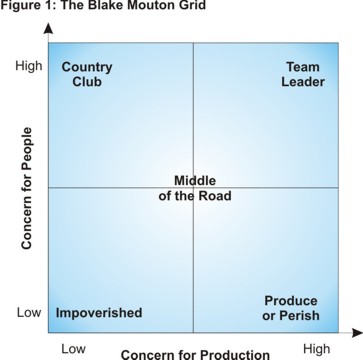
 Describe and explain the ‘managerial grid’ developed by Blake and Mouton. Think about someone you have worked for and identify the leadership style they used and where they would fit on Blake and Mouton’s grid and explain why


Reference: http://www.mindtools.com/media/Diagrams/BlakeMoutonGrid.jpg

The Blake and Mouton Managing Grid is one of the best ways to identify managers and leaders because it is split into five sectors which are: social, impoverished, middle of the road, authoritative and team manager.
This is a two dimensional chart – which means that if the managers score high on concern for people but score low on concern for production they care more about people then production.
These five sectors identify different styles of management, identified by Blake and Mouton (1964).

Social managers are positioned near the top of the grid but low on production which means they care about the staff more and they are quite relaxed on production.

Impoverished managers are positioned near the bottom of the grid which means that they require the minimum work (production) and concern of people.

Middle of the road managers are positioned in the middle of grid and have balance on the work load and people needs. These managers do not go the extra mile unless they have been ordered to.


Authoritative managers are positioned on the bottom of the chart which means they have low concern for people but care more on production because they want the work to be done and reaches the deadlines.

Team managers are positioned on the top of the chart on both sectors which means they care about both and try to develop a win-win situation. They are the ideal managers to work for.

Overall managers that score low on concern for production usually have weak organising skills and leave things to the last minutes.

In my case when I worked for Anthony Estate Agent as an office junior, the manager was very kind to me and I felt part of the team and after work we usually socialised with other members of staff. Also he listened to all our ideas and everyone felt motivated.


 Find an article/weblink that discusses a leader and briefly summarise what is has to say about them and their approach to leadership (include a link to the article in your blog) or choose an example of a strong leader from the exercise in the lecture, and explain why you believe he/she is a strong leader


Reference: http://images.mirror.co.uk/upl/m4/dec2008/3/9/88C6A182-E116-9250-26E2BD306BD5C253.jpg

A strong leader that I have chosen is Peter Jones because by the age of 16 he started his business and made it successful.
At a young age Peter Jones dreamed of being a chief executive operator of a big company and pretended in his dad’s office.
So at a young age he knew what he wanted in the future. In his school career he always wanted to do the best he could do and knowing that one day he could be a multi millionaire.
At the age of 16 he had completed the Lawn Tennis Association coaching exams and started his own tennis school.
In his twenties he moved into the computer industry and made it successful, but in his late twenties he lost most of his business through personal mistakes. Companies that associated with Peter Jones went bust so he was forced to sell most of his assets, for example, cars and house. He nearly became bankrupt.
In the same year Peter has joined Siemens Nixdorf and started Phone International Group in 1998. Now its become one of the leading brands in the UK. The business now generates over £200 million a year.
By the age of 40 Peter was considered to be one of the UK’s leading businessmen.
In 2002 The Times / Ernst and Young recognised his business as a up and coming entrepreneur and in 2003 he came in 13th of fastest growing business according to The Sunday Times.


http://www.peterjones.tv/index.cfm?fuseaction=PeterJones.About_Me

Remember to include a conclusion and evaluation at the end of this topic area on leadership.

In this conclusion every company has its own culture and everyone (person) is different. Every company has two different cultures which are hidden and visual. Every theory cannot identify all the areas in a company, for example hidden culture which can not be seen by customers only by staff. Putting companies into groups does not show how they work because all companies nowadays use and mixture of styles.


Bibliography and References

Benson, D (2003) Managers are not necessarily leaders [online] Available at: http://www.thefabricator.com/CEOs/CEOs_Article.cfm?ID=634 [Accessed 10 November 2009]

Callander, R (2009) Leadership [online] Available at: http://www.realbusiness.co.uk/news/leadership/5701436/win-the-chance-to-meet-dragon-peter-jones-thanks-to-bt-business.thtml [Accessed 10 November 2009]

Changing minds (2002) Leadership vs management [online] Available at: http://changingminds.org/disciplines/leadership/articles/manager_leader.htm [Accessed 10 November 2009]

Jones, P (n.d) Biography [online] Available at: http://www.peterjones.tv/index.cfm?fuseaction=PeterJones.About_Me&content_id=27 [Accessed 10 November 2009]


Jones, P (2009) Seriously business entrepreneur [online] Available at: http://www.seriouslybusiness.co.uk/2006/11/23/peter-jones-dragons-den-special/ [Accessed 10 November 2009]

Wednesday, 4 November 2009

Week 4 Organisation Culture

1.Provide some examples of the ‘visible’ aspects of culture in an organisation of your choice – what are some hidden aspects? To gain this information use your own work experience or base it on a company you visited within The Eden Centre as part of the lecture.

In different countries have different culture and that goes for the same in companies.
The organisation that I have chosen is Beaver Brooks. The culture in there is relaxed and basically staff enjoy the working environment.
In Beaver Brooks there are two features which are visible and hidden. Visible features are things that anyone can see even customers, for example: uniform, shop floor space, working culture – communication and language style.
The hidden culture is behind the shop floor, for example training – team building exercise and how staff communicates to the head office.
Beaver Brooks is still family owned and they have just celebrated their 90th anniversary. Over the years Beaver Brooks has won numbers of awards and they are well recognised in their own field.
According to one of the managing directors their culture is based on creating a positive and caring culture and this makes their colleagues feel that they are being listened to and their opinions have been taken in to accounts and they are delighted to have achieved these honours.

2.Explain what Handy meant by the following in your own words:
 A power culture
 A role culture
 A task culture
 A person culture

with an organisational example of each

Charles Handy’s theory is one of the best known in is field and it has identified different cultures in different companies.
Here are the brief explanations for different culture that you can see in a company.

Power culture according to Charles Handy is based on family owned businesses for example Beaver Brooks, John Lewis and solo traders. All these companies are still family owned businesses. This suggests that all the important decisions are made by probably one person.

Role culture is based on rules and procedure. This is mainly used in large organisations and everyone knows their tasks, for example factory workers they will be told what to do and how.

Task culture is based on team work from different departments. This type of culture is more like a team work based and staff have different tasks to complete for example in Siemens the Research and Development Department and Marketing Department work together to design new technology that customers will wants. They will be given different tasks to complete, for example in the Marketing Department they will gather all the information on the customers’ needs and wants and the R and D Department will try to make it. This can also motivate their staff because they will have the chance to work with other departments of staff and it can make them feel they are not trapped in one department.
They have one goal in common which is to improve the company processes for that I meant communication, relationship between different department and market shares.

Person culture – you can usually find it in creative companies, for example advertising companies, for example Boost Marketing. This allows every person to come up and express their ideas and get involved in making decisions.
When staff are planning draft ideas every member of staff will come together and shows areas that they are good at, for example coming up with new ideas for slogans, and the other member of staff is good at creative drawings and every member has one goal is to satisfy their clients.


http://www.lindsay-sherwin.co.uk/guide_managing_change/html_overview/05_culture_handy.htm


3. What do you think are the problems of trying to classify culture into one of the four types described above?

Overall every company uses more than one style to keep the company going because in different departments or situations the theory may not work so they will need to merge different theories together and finding new ways to solve different situations.
Each classify culture does not give the full picture of organisation because in one organisations can fit in to different cultures e.g. by departments.

4. Provide a link within your blog to a company or organisation which you feel demonstrates a strong culture. Explain why you have chosen this company.

Beaver Brooks
The reason why in have chosen Beaver Brooks is because when I walked into the shop floor the atmosphere was very comfortable and the staff was very friendly and polite. There visual culture was very well presented and their staff was well knowledge in the products that they are selling.


5.Remember to end this topic with a summary of your findings in a conclusion and evaluation.

In this conclusion every company have different culture and member of staff is different from each other for example personality. Just by investigating the company culture does not give a clear picture of the company because there is hidden culture that not everyone is able to see.
Also in Charles Handy’s theory and other theories does not show all the aspect of the company because nowadays company uses mixture of styles to motivate their staff.


Bibliography and References

Beaver brooks the jewellers (n.d) About us [online] Available at: http://www.beaverbrooks.co.uk/index.cfm?event=showAboutUs
[Accessed 29 October 2009]

Free management library (2000) Organisational culture [online] Available at: http://managementhelp.org/org_thry/culture/culture.htm [Accessed 29 October 2009]